The packaging industry is entering a new phase.
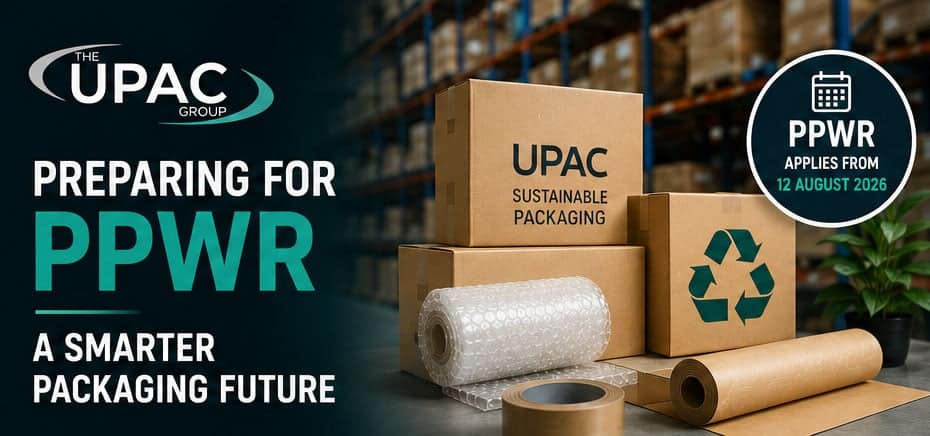
The Packaging and Packaging Waste Regulation (PPWR) will generally begin to apply from 12 August 2026, introducing a harmonised EU framework covering packaging design, composition, recyclability, reuse and waste prevention.
For businesses across the supply chain, this means packaging needs to be considered differently.
It is no longer enough to ask whether packaging protects a product.
We also need to ask:
How much packaging is being used?
What is it made from?
How efficiently is it being used?
Can it be reduced?
Can it be recycled or recovered?
At UPAC, we have already started looking closely at these questions.
Moving beyond packaging supply
As a packaging supplier, our role is not simply to provide boxes, protective materials, tape, strapping and other packaging products.
We want to help businesses understand how packaging can affect their costs, efficiency, logistics and environmental impact.
The PPWR provides an important opportunity to look at packaging from the entire lifecycle rather than considering the packaging product in isolation.
The European Commission states that the regulation covers packaging throughout its lifecycle, from production and design through to waste management.
That means packaging efficiency starts much earlier than the moment a parcel leaves a warehouse.
Packaging reduction can also mean cost reduction

One of the most practical outcomes of reviewing packaging is the potential to reduce unnecessary cost.
For many businesses, packaging represents more than the purchase price of boxes or protective materials.
It can also affect:
- Warehouse storage
- Packing time
- Void fill consumption
- Delivery volume
- Transport efficiency
- Waste management
- Purchasing requirements
A packaging optimisation programme therefore has the potential to deliver both environmental and commercial benefits.
The European Commission specifically highlights that using less packaging can save resources, reduce waste-management costs and reduce greenhouse-gas emissions.
Right-sizing: a simple place to start

One of the clearest areas for improvement is packaging size.
An oversized box creates unnecessary space around a product. That space often needs to be filled with additional protective material, while the larger package also occupies more space during storage and transportation.
For e-commerce in particular, the European Commission has highlighted the need to reduce empty space in delivery packaging.
Right-sizing does not mean choosing the smallest possible box.
It means choosing a packaging format that provides the required protection without unnecessary material or empty space.
Data is becoming increasingly important

One of the first steps towards improving packaging is understanding what is currently being used.
That is why UPAC has started introducing a new packaging information collection process.
The purpose is to build a clearer picture of packaging associated with orders and understand the different packaging materials being used.
Depending on the order, information can include the packaging types and quantities involved, allowing us to build a more detailed view of packaging composition and material usage.
This approach allows us to move from assumptions to data.
Instead of simply asking:
“Can we reduce packaging?”
we can begin asking:
“Where are we using the most packaging, what materials are involved, and where are the realistic opportunities to reduce it?”
Building a packaging data picture
The information we collect can help us analyse packaging across different areas of the business.
For example:
Packaging type
What packaging formats are being used?
Material
What materials make up the packaging?
Quantity
How much packaging is being used?
Order composition
How does packaging usage vary between different orders?
Percentage
What proportion of the packaging used is represented by different materials?
Opportunities for reduction
Where could packaging potentially be reduced, simplified or optimised?
This information can become increasingly valuable as businesses prepare for the changing regulatory environment.
Recyclability and material efficiency

The PPWR aims to make packaging more recyclable and reduce the use of virgin materials. The European Commission states that all packaging on the EU market should be recyclable in an economically viable way by 2030, alongside measures to increase recycled content in plastic packaging.
For packaging suppliers and users, this makes material selection increasingly important.
The question is no longer simply:
“What packaging can do the job?”
It is becoming:
“What packaging can do the job efficiently, while meeting future expectations for recyclability and material use?”
Preparing before compliance becomes a problem
At UPAC, we believe preparation should happen before businesses are forced to react.
The PPWR is already here. The regulation entered into force on 11 February 2025, with general application beginning on 12 August 2026.
That gives businesses an important reason to review their current packaging processes now.
For us, that means beginning with the fundamentals:
Understand the packaging.
Capture the data.
Identify unnecessary material.
Review packaging efficiency.
Look for opportunities to reduce waste and cost.
Prepare for the direction of future regulation.
From compliance to opportunity
Regulation is often viewed purely as a cost or administrative burden.
But packaging regulation can also encourage better business practices.
A company that reduces unnecessary packaging may reduce material purchasing.
A company that right-sizes packaging may improve warehouse efficiency.
A company that reduces empty space may improve transport utilisation.
A company that understands its packaging materials may make better purchasing decisions.
And a company that begins collecting packaging data early will have a stronger foundation for responding to future requirements.
That is why we see PPWR preparation as more than a compliance exercise.
It is an opportunity to build smarter packaging systems.
UPAC: preparing for what comes next
At UPAC, we are continuing to review the implications of PPWR and the wider movement towards more efficient, recyclable and responsible packaging.
Our new packaging information collection process is one part of this work.
By developing better visibility of packaging used across orders, we can begin identifying where improvements can be made and support our customers with more informed packaging decisions.
We believe the future of packaging is not simply about using a different material.
It is about using the right material, in the right quantity, in the right format, for the right application.
That is better for efficiency.
It can be better for cost.
And ultimately, it can mean less packaging waste.
The next step is simple: measure what you use.
Because once you understand your packaging, you can start improving it.
PPWR requirements differ depending on packaging type, application, market and the role of the business within the supply chain. This article provides general information and should not be treated as legal or regulatory advice.